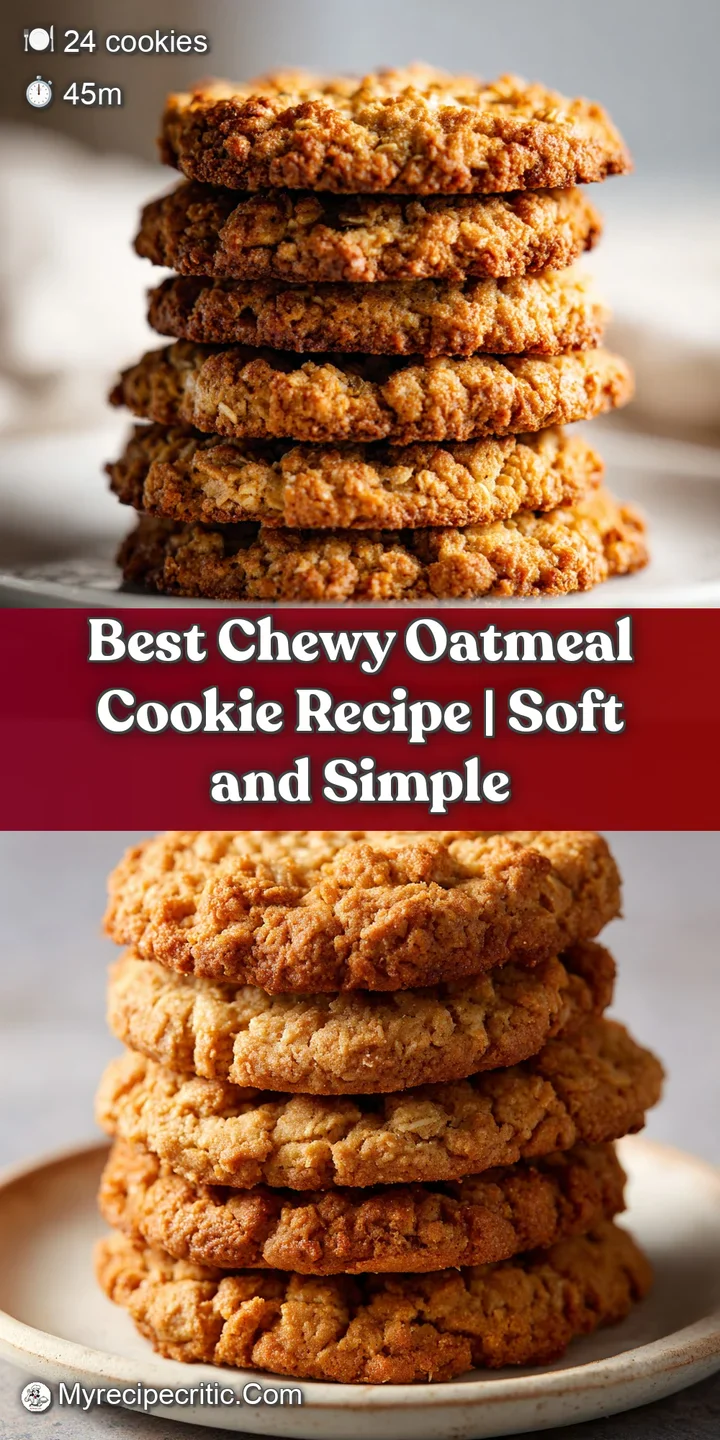
Chewy Oatmeal Cookie Recipe: Soft Centers
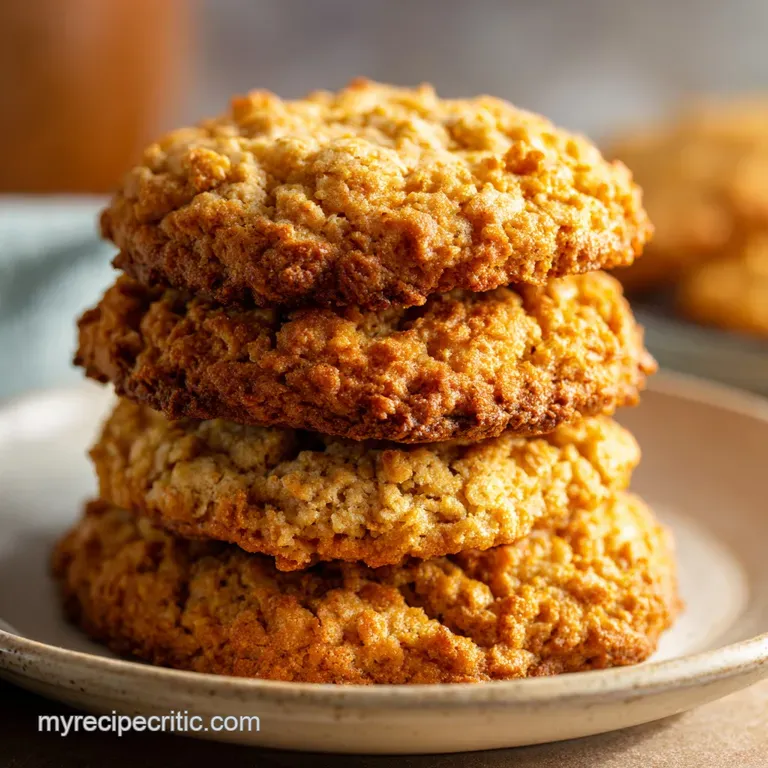
- Time: Active 35 minutes, Passive 10 minutes, Total 45 minutes
- Flavor/Texture Hook: Velvety center with a subtle cinnamon crackle
- Perfect for: Cozy afternoon snacks or reliable bake sale favorites
- Mastering This Classic Oatmeal Cookie Recipe
- The Science of Chewy Cookie Texture
- Precise Specs for Success
- Choosing the Right Ingredients
- Must Have Kitchen Tools
- Step-by-Step Baking Guide
- Solving Common Baking Problems
- Flavorful Dough Variations
- Storage and Zero Waste Tips
- Serving and Enjoyment Tips
- Recipe FAQs
- 📝 Recipe Card
Mastering This Classic Oatmeal Cookie Recipe
The first thing you notice isn't the sight of the cookies, but that warm, woody aroma of toasted cinnamon hitting the air the second the oven door opens. I remember making a batch of these for a neighbor's housewarming party last autumn.
I was worried they might turn out dry, but the moment I pulled the tray out and saw that gentle crackle on the surface, I knew we had a winner. The kitchen smelled like a hug, and honestly, that’s exactly how these taste.
When you bite into one, you get that immediate shatter of the golden brown edge followed by a center so soft it feels almost like fudge. It's the kind of treat that makes you want to pour a cold glass of milk and just forget about your phone for twenty minutes.
We’ve all had those oatmeal cookies that feel like chewing on a piece of cardboard, right? This isn't that. This is about building layers of flavor that actually behave in the oven.
I’ve spent a lot of time testing how different sugars and fats interact in this specific oatmeal cookie recipe. What I found is that the moisture in the 200g of dark brown sugar is the secret to that "bendable" quality we all crave.
We’re going to walk through exactly how to get that velvety dough texture so you can skip the trial and error I went through. Trust me on this, once you see how the ingredients come together, you’ll never go back to a box mix again.
The Science of Chewy Cookie Texture
Building a better cookie is all about managing moisture and protein. When we combine the 190g of all purpose flour with 300g of rolled oats, we are balancing the structural "snap" of the flour with the heavy, fiber rich chew of the oats. If you want to dive deeper into the mechanics of cookie dough, you might find some similar logic in how to How to Make recipe to understand the role of melted versus softened fats.
- Hygroscopic Action: The high molasses content in dark brown sugar attracts water from the air, keeping the cookies soft long after they’ve cooled.
- Starch Gelatinization: As the oats bake, they absorb moisture from the 2 eggs and butter, swelling slightly to create a dense, satisfying bite.
- Protein Denaturation: The 2 large eggs provide the structural "net" that holds the heavy oats in place as the baking soda creates lift.
- Fat Emulsification: Creaming the 226g of unsalted butter with sugar incorporates tiny air pockets that expand, preventing the cookie from becoming a flat disc.
| Thickness | Internal Temp | Rest Time | Visual Cue |
|---|---|---|---|
| 1/2 inch | 175°F (80°C) | 5 minutes | Edges are deep amber |
| 3/4 inch | 180°F (82°C) | 10 minutes | Center looks slightly underdone |
| 1 inch | 185°F (85°C) | 12 minutes | Surface crackle is fully set |
Right then, before we move into the specifics of the ingredients, it’s important to understand that the temperature of your kitchen can actually change how the dough behaves. If your butter is too warm, the cookies will spread into puddles.
We want that butter softened to room temperature enough that your finger leaves a soft indent, but not so much that it's oily or shiny.
Precise Specs for Success
Consistency in baking comes down to the details. I always suggest using a digital scale for these measurements because a "cup" of oats can vary wildly depending on how tightly you pack it. For this oatmeal cookie recipe, the 300g of oats needs to be exact to ensure the dough doesn't get too crumbly.
| Component | Science Role | Pro Secret |
|---|---|---|
| Dark Brown Sugar | Moisture retention | Pack it firmly to ensure the full 200g weight. |
| Old Fashioned Oats | Texture & Fiber | Never use instant oats; they turn to mush. |
| Vanilla Bean Paste | Flavor Depth | Paste adds those beautiful tiny black specks. |
| Baking Soda | Leavening & Browning | Check the expiration date for a proper rise. |
If you have ever wondered why some cookies look pale while others are a beautiful mahogany, it’s usually the pH balance. The baking soda reacts with the acidic brown sugar to encourage the Maillard reaction, which is a fancy way of saying "it makes things brown and tasty."
Choosing the Right Ingredients
Selecting your elements is the first step toward that bakery style finish. Don't settle for whatever is in the back of the pantry; fresh spices and high-quality fats make a massive difference here.
- Unsalted Butter (1 cup / 226g): Softened to room temperature. Why this? Allows you to control the salt levels perfectly.
- Substitute: Salted butter (just omit the extra sea salt).
- Dark Brown Sugar (1 cup / 200g): Packed tightly. Why this? Higher molasses content than light brown sugar for extra chew.
- Substitute: Light brown sugar with 1 tsp of molasses added.
- Granulated Cane Sugar (1/4 cup / 50g): Why this? Helps the edges get that necessary crunch.
- Substitute: Coconut sugar for a more toasted, nutty vibe.
- Large Eggs (2): Must be at room temperature. Why this? Cold eggs will curdle your creamed butter instantly.
- Substitute: Flax eggs (may result in a denser, less risen cookie).
- Vanilla Bean Paste (1 tbsp): Why this? Concentrated flavor that won't bake off in the heat.
- Substitute: Pure vanilla extract.
- All Purpose Flour (1 1/2 cups / 190g): Why this? Provides the "goldilocks" amount of protein for structure.
- Substitute: 1:1 gluten-free baking flour blend.
- Old Fashioned Rolled Oats (3 cups / 300g): Why this? Large flakes provide the best mouthfeel.
- Substitute: Quick oats (note: cookies will be much drier and flatter).
- Semi sweet Chocolate Chips (1 cup / 170g): Why this? Cuts through the sweetness of the dough.
- Substitute: Raisins or chopped walnuts.
Chef’s Tip: Before you start mixing, toast your oats in a dry pan for 5 minutes until they smell nutty. It adds a whole new dimension of flavor that most people skip!
Must Have Kitchen Tools
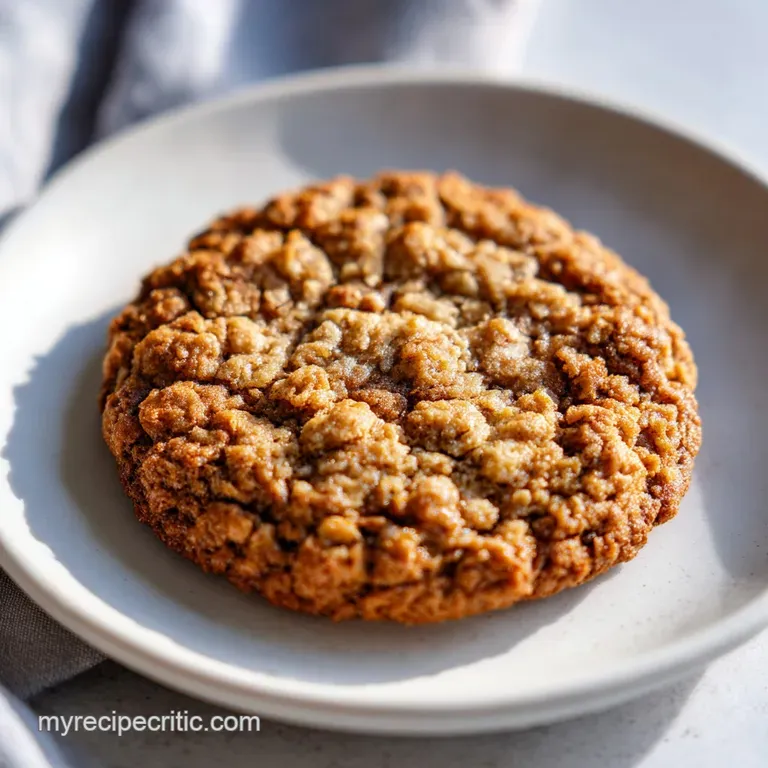
You don't need a professional bakery setup, but a few specific tools will make your life much easier. I personally swear by a heavy stand mixer, but a hand mixer works just as well if you have the patience for it.
- Digital Kitchen Scale: Essential for weighing your 190g of flour and 300g of oats.
- Electric Mixer: Either a stand mixer or hand held to properly cream the butter.
- Large Baking Sheets: Heavy duty rimmed sheets prevent the bottoms from burning.
- Silicone Baking Mats: These ensure the cookies release easily without sticking.
- Cookie Scoop (2 tbsp size): The only way to ensure all 24 cookies are the same size.
- Wire Cooling Rack: Crucial for airflow so the bottoms don't get soggy.
step-by-step Baking Guide
Let's get into the actual process. This is where we build those flavor layers I mentioned. Pay attention to the visual cues they are more important than the timer!
Phase 1: Creaming Foundation
- Cream the butter and sugars. Beat the 226g of softened butter, 200g of dark brown sugar, and 50g of cane sugar on medium high until the mixture is pale, fluffy, and looks like velvety frosting.
- Incorporate the liquids. Add the 2 large eggs and 1 tbsp of vanilla bean paste. Beat for 2 full minutes until the dough texture is smooth and emulsified.
Phase 2: Incorporating Dry Goods
- Whisk the dry ingredients. In a separate bowl, combine the 190g of flour, 1 tsp baking soda, 1 tsp cinnamon, and 0.5 tsp sea salt. Note: This prevents clumps of soda in your cookies.
- Combine the mixtures. Slowly add the dry ingredients to the wet. Mix on low only until the white streaks of flour just disappear.
- Fold in the texture. Add the 300g of rolled oats and 170g of chocolate chips. Fold by hand with a spatula until the oats are evenly distributed.
Phase 3: Critical Bake
- Chill the dough. Cover and refrigerate for 30 minutes. Note: This prevents the cookies from spreading too thin.
- Preheat and prep. Set your oven to 350°F (180°C) and line your trays.
- Scoop and space. Place 2 tablespoon mounds of dough 2 inches apart.
- Bake the batch. Cook for 10 minutes until the edges are golden brown and the centers still look slightly soft.
- Cool and set. Let the cookies sit on the hot tray for 5 minutes until they are firm enough to move to a wire rack.
| Feature | Fresh Homemade | store-bought Dough |
|---|---|---|
| Texture | Velvety and chewy | Greasy and soft |
| Flavor | Toasted oat and vanilla | Artificial vanilla |
| Cost | ~ $0.40 per cookie | ~ $0.80 per cookie |
While these are cooling, you might notice the smell is absolutely intoxicating. If you enjoy this style of baking, you'll probably love The Classic Scottish recipe for its similar focus on high-quality butter and simple, clean flavors.
Solving Common Baking Problems
Even the best of us run into trouble sometimes. Baking is basically a science experiment you can eat, so if things don't go as planned, there's usually a very logical reason for it.
Why Your Cookies Spread
If your cookies come out looking like thin pancakes, it's almost always a temperature issue. If the 226g of butter was too soft (or melted), it won't hold the air bubbles needed for lift. Alternatively, if you skipped the 30 minute chill time, the fat will melt faster than the flour can set.
Why Your Cookies Are Tough
Overmixing is the enemy of a tender cookie. Once you add the 190g of flour, you start developing gluten. If you keep the mixer running too long, that gluten becomes a rubbery web. Stop mixing the second you don't see any more dry flour!
| Problem | Root Cause | Solution |
|---|---|---|
| Dry/Crumbly | Too many oats | Use a scale to ensure exactly 300g of oats. |
| Burned Bottoms | Dark baking sheet | Use parchment paper or move rack to middle position. |
| Greasy Texture | Butter was too warm | Chill the dough for an extra 20 minutes before baking. |
Common Mistakes Checklist
- ✓ Ensure eggs are at room temperature to prevent the butter from seizing.
- ✓ Never use "Quick" or "Instant" oats; they lack the structure for a chewy cookie.
- ✓ Use a cookie scoop for uniform size, which ensures uniform baking times.
- ✓ Let the baking sheets cool completely between batches so the dough doesn't melt on contact.
- ✓ Always check your baking soda by putting a pinch in vinegar; if it doesn't fizz, toss it.
Flavorful Dough Variations
Once you've mastered the base oatmeal cookie recipe, the world is your oyster. This dough is incredibly sturdy and can handle a lot of different mix ins.
- For a Chocolate Variation: Swap the semi sweet chips for 170g of white chocolate chips and add 1/2 cup of macadamia nuts for a tropical twist.
- For a Quick Variation: If you’re in a rush, you can skip the chill time by adding an extra 2 tbsp of flour to the 190g base, though the texture won't be quite as velvety.
- For a Nutty Boost: Replace 1/4 cup of the oats with 50g of toasted chopped pecans or walnuts for an earthy crunch.
If you want to try something even more decadent, you could adapt the technique from this Cookie Dough Pretzel recipe and stuff a small piece of chocolate or caramel inside each oat cookie ball before baking.
- To Half (12 cookies)
- Use 113g butter, 100g brown sugar, 25g cane sugar, and exactly 1 egg. Reduce the vanilla to 1.5 tsp.
- To Double (48 cookies)
- Use 452g butter and 400g brown sugar. Be careful with the leavening; use only 1.5 tsp of baking soda to prevent a soapy aftertaste.
- Baking Double
- Lower the oven temp by 25°F (to 325°F / 165°C) if using two racks at once, and rotate the pans halfway through.
Storage and Zero Waste Tips
Keeping these cookies fresh is easy because of that dark brown sugar we used. It holds onto moisture like a sponge!
- Fridge Storage: Keep them in an airtight container for up to 7 days. If they start to get hard, toss a slice of white bread into the container; the cookies will absorb the moisture from the bread and soften right back up.
- Freezer Storage: You can freeze the baked cookies for up to 3 months. To reheat, just pop them in a 300°F (150°C) oven for 5 minutes.
- Zero Waste: If you have crumbs or broken cookies at the bottom of the jar, don't throw them out! Pulse them in a blender and use them as a "crust" for a cheesecake or sprinkle them over vanilla ice cream for a DIY "Oatmeal Cookie" sundae.
Serving and Enjoyment Tips
These cookies are best served just slightly warm, about 15 minutes after they come out of the oven. This gives the chocolate chips (170g) time to set just enough so they don't smear everywhere, but they’re still gooey in the center.
For a Bendable Center
If you prefer a cookie that is almost "doughy," pull them out of the oven at exactly 9 minutes. They will look undercooked, but the carryover heat from the baking sheet will finish them off perfectly without drying out the oats.
For Caramelized Edges
For those who live for the crunch, leave them in for 11 or 12 minutes. The sugars will begin to slightly burn at the edges, creating a deep, toffee like flavor that pairs beautifully with a strong cup of black coffee or a spicy chai tea.
Myths About Oatmeal Cookies
- Myth 1: You must soak oats first. False. Soaking oats makes the dough too wet and leads to a mushy cookie. The 10 minute bake time is plenty to soften the oats while keeping their bite.
- Myth 2: Butter temperature doesn't matter. This is the biggest lie in baking! If your butter is "greasy" or melted, the cookies will never have that velvety interior.
- Myth 3: Raisins are mandatory. Absolutely not. While classic, the chocolate chip oatmeal cookie recipe variation is often a much bigger hit with kids and adults alike.
Honestly, don't even bother with low-fat butter or margarine here. The 226g of real creamery butter is what provides the flavor and the structure. Let's crack on and get a batch in the oven you deserve it!
Recipe FAQs
What are the most common mistakes making oatmeal cookies?
Overmixing the flour. Once the flour is added, mixing too long develops gluten, resulting in tough, rubbery cookies instead of chewy ones. Stop mixing as soon as the dry streaks vanish.
Are oat cookies actually healthy?
No, not inherently. While oats offer fiber, standard recipes are high in sugar and fat, making them an indulgence. They are nutritionally better than cookies without oats, but treat them as a dessert.
What happens if you use regular oats instead of quick oats in cookies?
The texture will be chewier and heartier. Quick oats break down too much, leading to a softer, almost cakey cookie; regular (old-fashioned) oats provide the necessary structure and recognizable texture.
What kind of oatmeal is best for oatmeal cookies?
Old-fashioned rolled oats are the clear winner. They provide the perfect balance of chewiness and structure; instant oats dissolve too much during baking, making the cookie mushy.
How do I prevent my oatmeal cookies from spreading too thin on the baking sheet?
Chill the dough for at least 30 minutes before scooping. Cold fat takes longer to melt in the oven, allowing the dry ingredients time to set before the cookie flattens completely.
Can I substitute white sugar for the dark brown sugar in this recipe?
No, you will lose the signature chewiness. Dark brown sugar contains molasses, which is hygroscopic, meaning it retains moisture and creates that soft, bendable texture you want.
How can I ensure my cookies are soft next day?
Use a high ratio of dark brown sugar to white sugar. The molasses in the dark sugar attracts ambient moisture, keeping the final product softer for longer; if you enjoyed learning this texture logic, see how we apply similar moisture control in the My Soft Chewy recipe.
Chewy Oatmeal Cookie Recipe
Ingredients:
Instructions:
Nutrition Facts:
| Calories | 227 calories |
|---|---|
| Protein | 3.3 g |
| Fat | 11.2 g |
| Carbs | 29.4 g |
| Fiber | 1.8 g |
| Sugar | 14.2 g |
| Sodium | 118 mg |
